- Dementia is an incurable disease which is becoming increasingly common.
- However, it is possible to prevent or delay its onset to some extent by making lifestyle changes.
- Mass screenings using artificial intelligence (AI) could aid early diagnosis and reduce the risk of dementia developing.
- Dr Kaoru Sakatani, the University of Tokyo, Japan, and colleagues have developed an AI model that predicts the risk of dementia using standard blood-test data and patient age.
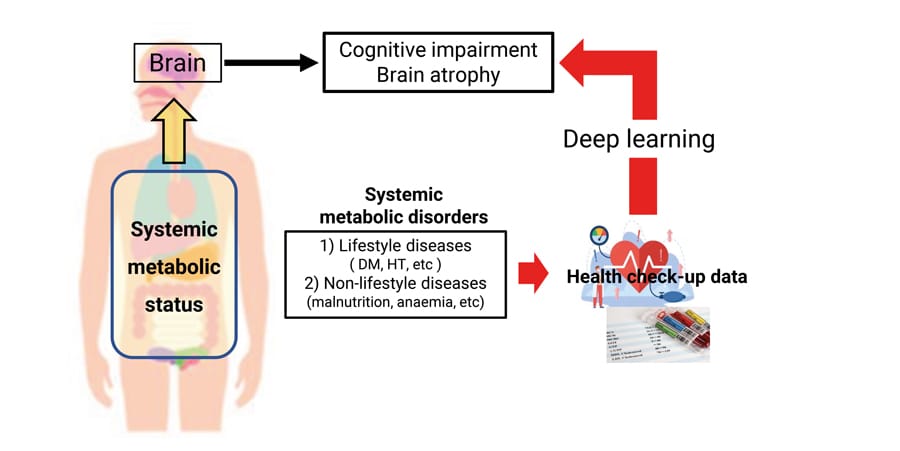
- Lifestyle-related diseases revealed by the blood results can have a systemic effect on the brain which increases dementia risk.
Alzheimer’s disease – a form of dementia – is characterised by a decline in the brain’s ability to function. In the early stages, this can cause forgetfulness and emotional changes, but as the disease progresses the ability to walk, eat, and care for oneself are severely affected. Unfortunately, the number of people with Alzheimer’s is expected to increase to over 100 million by the year 2050, according to the World Alzheimer Report.
What’s more, there is no cure. Therefore, clinics focus on a two-pronged approach: diagnosing the disease early to ensure timely and appropriate help, and prevention strategies to reduce the risk of dementia developing at all. Mass screenings, whereby large populations are tested for risk factors or early symptoms, could aid both these approaches.
However, current methods for diagnosing dementia, even at its earliest stages, are not practical, economical, or ethical to carry out at such a scale. The Mini-Mental State Examination (MMSE) questionnaire to evaluate cognitive function is commonly used but is subjective and time consuming; MRI scans are expensive; and the biomarker of Alzheimer’s disease (amyloid beta) can only be detected using an invasive procedure. To overcome these challenges, researchers and clinicians have employed the help of artificial intelligence (AI).

Decoding AI
To the uninitiated, AI – in particular, the subset of AI known as deep learning – is an unfathomable black box. Put simply, however, deep-learning algorithms or deep neural networks are computer-coded maths that function in comparable ways to the human brain. The algorithms can decipher complex and complicated patterns within huge amounts of data. Once trained on information that represents ‘ground truth’, they can then assume new knowledge from similar data that is thrown at them.
In daily life, these algorithms are suggesting which online items you should put in your shopping cart next and beating world champions at the game Go. But deep learning has the potential to improve our lives in profound ways, one example being healthcare.
You could find out your risk of dementia by simply entering your health data into your smartphone.
Predicting dementia
Dr Kaoru Sakatani at the University of Tokyo, Japan, and colleagues at Nihon University in Tokyo, asked if deep neural networks could be used to predict the risk of dementia with the help of readily available clinical information. The researchers developed a deep neural network that could predict mental function and cerebral atrophy (degradation of the brain tissue) using basic health check-up information such as standard blood test data and patient age.
‘First, we used our deep neural network to analyse the relationship between hospitalised patients’ blood tests and their results from the commonly-used MMSE questionnaire,’ explains Sakatani. ‘Next, we needed to validate our model on data that the neural network had not yet encountered.’
This meant inputting into the deep neural network the blood test results of new groups of people, asking the deep neural network to predict the MMSE scores, and then comparing these predictions against the actual scores. In people who had been hospitalised for rehabilitation following a stroke, the deep neural network accurately predicted the MMSE scores.
Interestingly, a relationship between a patient’s blood test results and an MRI scan showing their brain anatomy also became apparent. This set the stage for further study aimed at understanding how the deep neural network could use a patient’s age and blood test results to estimate brain degradation and thereby mental function. The researchers found that ageing had the biggest effect on brain degradation, but that blood test results were also an important factor.
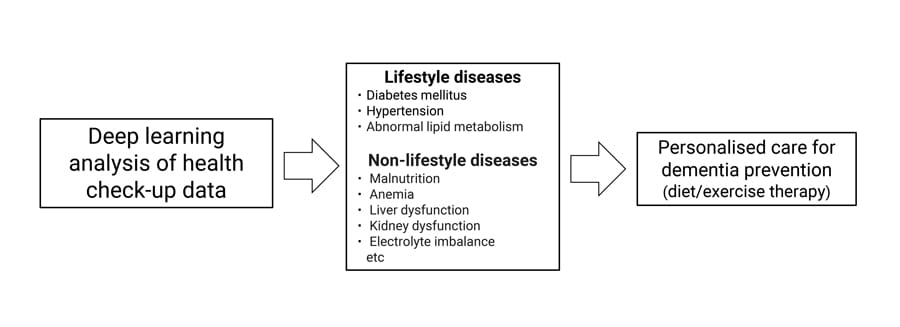
Personalised care for prevention of dementia based on deep-learning analysis of health check-up data.
Joining the dots
Deep neural networks are well placed to find and predict relationships within data that are too complex for humans to comprehend. Once the patterns are identified, however, human intelligence is needed to understand why they exist. So why can blood test results predict the risk of dementia?
You could find out your risk of dementia by simply entering your health data into your smartphone.
Sakatani explains that although dementia is a disease of the brain, the risk of developing dementia in the elderly can be affected by systemic metabolic diseases: ‘blood tests indicate when a person has one or more systemic metabolic diseases such as hypertension, diabetes, malnutrition, anaemia, or dysfunctions of the liver and kidneys.’
These diseases have a direct impact on a person’s health – such as their blood pressure or ability to control their blood glucose levels – but they also reduce blood flow to the brain. Less blood flow to the brain, known as vascular cognitive impairment, is known to play a role in the development of cognitive impairment in the elderly with Alzheimer’s disease, especially cerebral atherosclerosis.

‘The deep neural network detected relationships between patients’ blood test results and their brain function and brain tissue degradation’, says Sakatani. ‘When the deep neural network was given blood test results from another patient, it used the learned relationships to predict the risk of dementia in the new patient.’
Healthy choices
As only health check-up data were required for the deep neural network to make its predictions, the model has the potential to enable inexpensive and large-scale screenings of dementia risk. ‘You could find out your risk of dementia by simply entering your health data into your smartphone,’ says Sakatani.
Importantly, this method may contribute not only to screening tests for dementia, but also to personalised care for the prevention of dementia; that is, the health check-up data, including blood test data, reflect systemic metabolic disorders that contribute to the dementia risk for each individual. Thus, it is possible to provide personalised lifestyle guidance – about diet and exercise therapy, for example – based on the abnormal health check-up data. Personalised care not only increases the effectiveness of interventions but also enhances lifestyle incentives.
How can this deep neural network be improved upon further?
To improve deep neural networks (DNNs), we believe the following research is needed. First, we examine how much the prediction/estimation accuracy of the DNN can be improved by adding data other than blood test data to the input parameters. For example, we examine the effects of past medical history, lifestyle habits such as smoking, sleep duration, etc, and physical findings like blood pressure and body mass index, on the prediction/estimation accuracy of DNN. In addition, we will examine the effects of inflammatory factors such as IL6 and CRP, and aspects of the blood test related to cognitive impairment, such as vitamin K. Moreover, using data in chronological order, we will develop a DNN model that predicts future dementia risk. Finally, we will examine the effect of combining the DNNs for predicting cognitive function and brain atrophy on the prediction/assessment accuracy. These studies not only improve prediction/estimation accuracy, but also reveal possible mechanisms by which systemic metabolic state may affect cognitive function.
What steps need to be taken before this deep neural network can be used more widely within communities?
For the DNN model to be widely used in communities, it first has to receive official medical device approval from the government. Before this can happen, we need to verify the prediction/estimation accuracy of the DNN model using various medical data.
How else do you think deep neural networks can influence and improve healthcare?
Until now, health check-up data has not been widely used for disease prevention. However, by analysing health check-up data using DNN, it is possible to predict and estimate the risk of dementia and provide individual preventive guidance, thereby reducing the number of dementia patients.
Currently, the Finnish Geriatric Intervention Study to Prevent Cognitive Impairment and Disability (FINGER) study on dementia prevention is being conducted worldwide. The FINGER study assumes that lifestyle-related diseases are the main risk factors for dementia, but our study also considered other metabolic disorders such as malnutrition, anaemia, liver and renal dysfunction, and electrolyte imbalances as risk factors. As a result, we can analyse dementia risk in more detail when compared to the FINGER study. Furthermore, by using the DNN model, diet and exercise therapies can be more accurately and individually tailored to individual subjects. We expect that introducing the DNN model into the FINGER study would lead to more effective suppression of dementia.
What further developments are you most excited about?
In addition to dementia, we are excited about the potential of using DNN for lifestyle-related geriatric conditions and diseases including stroke, heart disease, frailty, locomotive syndrome, and sarcopenia. By changing the output layer of DNN to these diseases of the elderly, it may be possible to predict and estimate them from health check-up data. In the near future, it may be possible to create a ‘Disease Risk Future Prediction (DRFP) chart’ that shows the future risk of geriatric diseases. By inputting annual health check-up data into the DRFP chart, it will be possible to visualise future changes in disease risk, leading to active diet and exercise therapy. This will extend healthy life expectancy and reduce government-borne medical costs.